
SOLITUDE – Artistic community project
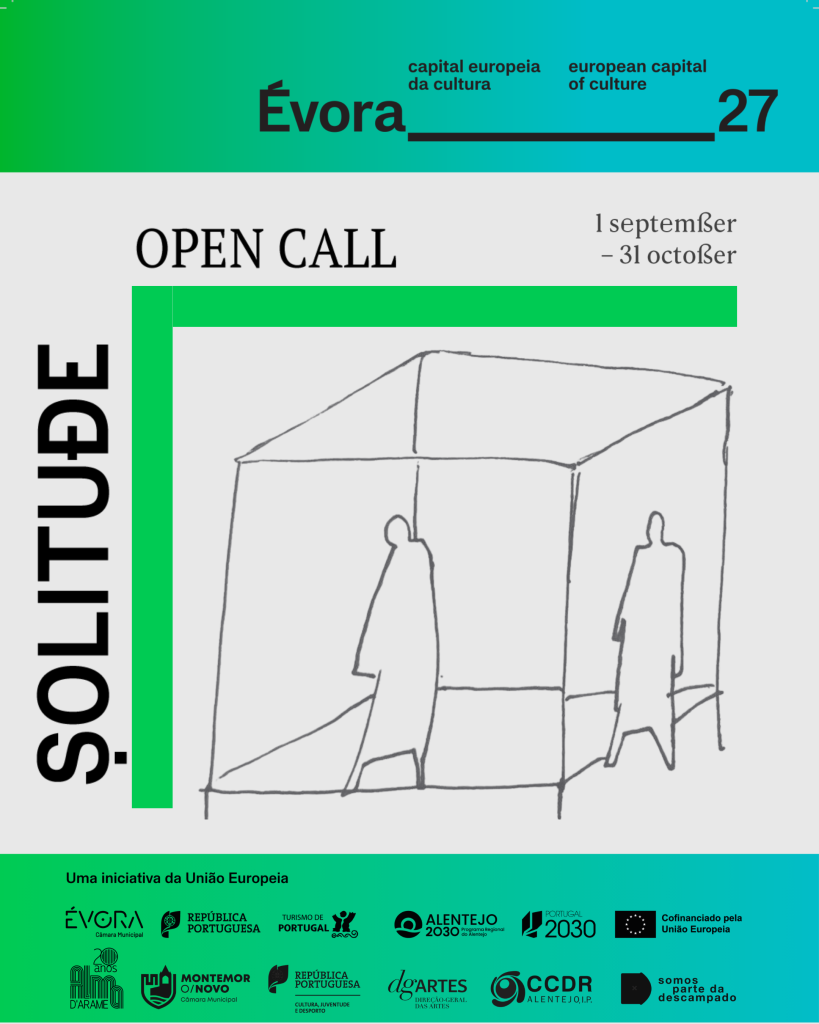
Applications are now open for participation in SOLITUDE, a community art project developed as part of Évora – European Capital of Culture 2027.
SOLITUDE focuses on the dual nature of solitude — as an experience of suffering and isolation, but also of inner reflection and self-examination — addressing it as a contemporary social phenomenon, particularly evident in the Alentejo due to the ageing population and the remoteness of the region. The project’s main objective is to explore the feeling of loneliness experienced by places and/or people, identified as a common experience shared amongst peers — whether positive or negative — and one that evokes a range of emotions in those who experience it.
The end result is the creation of four performances (the “solitudes”), in which each selected participant will work in pairs with one of the project’s four performance artists, drawing on their own experiences, memories and life stories.
To this end, we are looking for 4 participants aged 65 or over from the four sub-regions of the Alentejo: Central Alentejo (municipality of Montemor-o-Novo), Coastal Alentejo (municipality of Sines), Upper Alentejo (municipality of Castelo de Vide) and Lower Alentejo (municipality of Serpa).
The "solitudes"
The choice of Castelo de Vide stems from a desire to cross borders. There, that line was never merely a mark on a map. It was a way of breathing. A territory where the body measured the distance between danger and freedom, between staying and leaving.
Between Portugal and Spain, an invisible geography took shape, made up of smuggling, escapes and resistance.
People walked at night. The silence had weight. Each crossing invented a new way of being. The body held the rhythm of the steps, the pause before the encounter, the detour, the wait. The border was etched onto the skin before it existed in the landscape.
Today, the path remains open, whilst the gestures are preserved in the memories of those who lived them. I am interested in that space where history becomes intimate, where a single bodily movement can convey an entire era.
The project stems from an encounter with a single person. A long conversation. Patient listening. Someone who wishes to open up their memories of crossings, of smuggling, of resistance, or simply of everyday life along the border. A single voice sufficient to bring many others to the surface.
Words, silence, puppets, objects and materials will form the basis of this exploration. I seek to follow the body’s memory: the way a gesture spans decades, how a movement remains present even when the landscape has changed.
With Vagar, I envisage a work that lies somewhere between an installation and a performance, where the border ceases to be a geographical boundary and once again becomes a place of passage. A space where the invisible takes on a physical form and where an individual memory continues to shift the way we view the present.
The research area was assigned to me by the project itself. As one of the artists not based in Portugal, I was given a specific area and a historical event from which to begin my work: the Portuguese Agrarian Reform of 1974 and 1975.
However, my interest lies not in the official historical narrative, but in what remains hidden beneath it. I am interested in getting closer to the lives of those who lived through that historical moment without ever featuring in the history books: the people who worked the land, the women who kept the households and cooperatives running, the young people of that time, the children who witnessed those transformations, the conversations around a table, the objects that are still preserved today, and the silences and contradictions that linger in the memory.
I want to work with people aged 65 or over who experienced the Agrarian Reform first-hand and to bring these memories into dialogue with young people born in a very different era. I am not seeking to reconstruct a historical event, but to create an encounter between generations, a space where memory can become a shared experience and not merely an account of the past.
The Portuguese Agrarian Reform of 1974 and 1975 occupies a unique place today: it remains close enough to still be recounted by those who lived through it, yet distant enough for those voices to begin to fade away. It is precisely at this threshold that this project takes shape.
We live in an age characterised by ever-increasing pace and a discourse that focuses solely on the present. The past seems to have ceased to matter, and the future is often viewed with uncertainty. I wonder whether it is possible to build a collective sense of hope when one of these aspects of time disappears. What happens to the social fabric when we stop nourishing it with memory and with our imagination of the future?
I imagine time as a living organism. The past is the roots that sustain us; the present is the trunk that keeps us standing; the future is the branches, the leaves and the flowers yet to bloom. Separately, these times lose their meaning. Together, they form a single body.
This project stems from a desire to care for this organism. To listen before interpreting. To recover small stories, fragmentary memories, forgotten photographs, everyday objects and anonymous voices that are at risk of disappearing. Because perhaps true History does not lie solely in the great events, but in the quiet lives of those who made them possible without ever becoming part of the official narrative.
In this sense, the project engages with the concept of ‘intra-history’, as formulated by Miguel de Unamuno – that deep, silent current which underpins visible History – and with the work of W. G. Sebald, who believed that collective memory is also constructed from the fragile traces of those who have remained on the margins of official narratives. Both invite us to look down, towards seemingly insignificant lives, to discover that it is precisely there that the true continuity of a community lies.
Rather than simply revisiting a historical episode, this project seeks to create a space where different generations can come together, listen to one another and collectively imagine new ways of relating to memory, territory and the future.
I was born in the Beira region, and am a true ‘tripeiro’ by choice, but I learnt to speak Portuguese with a coastal Alentejo accent. I lived in Sines from the late 1970s to the early 1980s. I cherish memories from that time which have become part of my personal and intimate mythology.
Events both big and small, discoveries, feats and adventures which, from the perspective of someone who still had a long way to go, were truly memorable.
We used to play in the street.
There was a ‘Space: 1999’ spaceship in the playground.
We’d have sardine barbecues.
We used to play at being doctors.
One day I followed the pipelines all the way to the refinery. The lighthouse beam cut across the sky, materialising in the night’s damp air. An oil tanker exploded in the harbour; the tugs saved the day. I saved my little sister from drowning in a flooded underpass. Above us, gigantic lorries laden with concrete elements for the construction of the jetty were passing by. There was tar in the beach sand, just like in Fausto’s song.
I struggled through life.
I took more than I gave.
I was a pacifist.
I tasted very spicy African food with the Cape Verdean labourers who were building the block next to my house.
I was an internationalist and an anti-racist.
We had a dog with long, dark brown fur; when we stopped, she stayed put. Idling. The time before work. I spent my early childhood in this town. Before I started school. School is children’s work. I realised it was a punishment that all boys and girls – even those who behave well – had to endure. By then, I was no longer living in Sines.
In Sines I discovered the world on my own, with a level of independence that extended beyond my body, the house and the courtyard. Walking alone and making friends along the way. When the streetlights came on, you had to go straight home. That was the rule in the Bairro Marítimo. Synesthesia
Memories and stories are like cherries: when you pick one, another always comes clinging to it. Memories sometimes bring stories, and the reverse is also true. At other times they bring different things: a smell, an emotion – the reverse can happen too. Through the winding channels of memory flows a fossilised mixture charged with energy. Memory is refined every time it is recalled, every time it is refreshed.
Today, the refinery still processes fossil fuels – organic matter that has decomposed and been compressed over millions of years. The data centre already processes and refines the cognitive matter of millions, decomposed and compressed. What today holds strategic and financial value may one day become forensic evidence – a spectre that hangs over every electronically recorded action taken today.
Will it all be turned into archaeology in the not-too-distant future? Or perhaps we are already producing a ‘future crude’, made from the memory and vital energy of billions. What are we going to do with all this? Between the past and the future, it is said that there is that elusive thing we call the present.
In this creative project, we will explore the perception of time; after all, were we talking about a lifetime or a summer’s afternoon? I reflected on my memories of Sines – I selected a small part: episodes from the life of a growing child, whilst at the same time offering clues to the history of the town and the country. Do our lives intersect with history as it unfolds? Are we even aware of this? Is it possible to bring memories into dialogue with one another? How might these be brought to life on stage?
We’re going to create a short play that sets out from questions like these onto a path that has yet to be invented.
Would anyone like to join this adventure?
The images I have of the Alentejo are those of someone who doesn’t know the region well – images of someone who has visited a town or village briefly, and more often than not the beaches. A superficial knowledge, that of a tourist who is lucky enough to speak the language, being from the north, from Porto. In my ignorance, I cherish the vast landscapes of the interior and the coastal cliffs. I also cherish the sounds of Alentejo folk singing.
When I was approached about the Solitude project by the Alma de Arame theatre company, I was faced with the need to choose a sub-region. The choice was not made by reason, but by feeling. It was the singing that prevailed as the greatest source of curiosity, as a connection to the people who remain in the region. That is why I chose the Lower Alentejo as the starting point for this adventure and, specifically, the town of Serpa as a base for my exploration.
Song will undoubtedly be one of the pillars of this encounter between myself, solitude (the overarching theme of this project), the region I have chosen, and the person I hope to find through this call for participation. The second pillar will consist of the stories that the partner in this creation will tell me. Stories of absence and solitude, in which those who have gone will be evoked through sung and spoken words, through actions, gestures and the objects that will be devised to tell these stories. Individual memory, the particular case, serves as a reflection or an echo of the fate of an entire region.
I see working with my partner as a true creative partnership: one provides the material to work with (memories, experiences); I will provide the means to anchor those memories on stage, through objects. Together, we will be responsible for giving voice to the absences and the silences.
The choice of Castelo de Vide stems from a desire to cross borders. There, that line was never merely a mark on a map. It was a way of breathing. A territory where the body measured the distance between danger and freedom, between staying and leaving.
Between Portugal and Spain, an invisible geography took shape, made up of smuggling, escapes and resistance.
People walked at night. The silence had weight. Each crossing invented a new way of being. The body held the rhythm of the steps, the pause before the encounter, the detour, the wait. The border was etched onto the skin before it existed in the landscape.
Today, the path remains open, whilst the gestures are preserved in the memories of those who lived them. I am interested in that space where history becomes intimate, where a single bodily movement can convey an entire era.
The project stems from an encounter with a single person. A long conversation. Patient listening. Someone who wishes to open up their memories of crossings, of smuggling, of resistance, or simply of everyday life along the border. A single voice sufficient to bring many others to the surface.
Words, silence, puppets, objects and materials will form the basis of this exploration. I seek to follow the body’s memory: the way a gesture spans decades, how a movement remains present even when the landscape has changed.
With Vagar, I envisage a work that lies somewhere between an installation and a performance, where the border ceases to be a geographical boundary and once again becomes a place of passage. A space where the invisible takes on a physical form and where an individual memory continues to shift the way we view the present.
The research area was assigned to me by the project itself. As one of the artists not based in Portugal, I was given a specific area and a historical event from which to begin my work: the Portuguese Agrarian Reform of 1974 and 1975.
However, my interest lies not in the official historical narrative, but in what remains hidden beneath it. I am interested in getting closer to the lives of those who lived through that historical moment without ever featuring in the history books: the people who worked the land, the women who kept the households and cooperatives running, the young people of that time, the children who witnessed those transformations, the conversations around a table, the objects that are still preserved today, and the silences and contradictions that linger in the memory.
I want to work with people aged 65 or over who experienced the Agrarian Reform first-hand and to bring these memories into dialogue with young people born in a very different era. I am not seeking to reconstruct a historical event, but to create an encounter between generations, a space where memory can become a shared experience and not merely an account of the past.
The Portuguese Agrarian Reform of 1974 and 1975 occupies a unique place today: it remains close enough to still be recounted by those who lived through it, yet distant enough for those voices to begin to fade away. It is precisely at this threshold that this project takes shape.
We live in an age characterised by ever-increasing pace and a discourse that focuses solely on the present. The past seems to have ceased to matter, and the future is often viewed with uncertainty. I wonder whether it is possible to build a collective sense of hope when one of these aspects of time disappears. What happens to the social fabric when we stop nourishing it with memory and with our imagination of the future?
I imagine time as a living organism. The past is the roots that sustain us; the present is the trunk that keeps us standing; the future is the branches, the leaves and the flowers yet to bloom. Separately, these times lose their meaning. Together, they form a single body.
This project stems from a desire to care for this organism. To listen before interpreting. To recover small stories, fragmentary memories, forgotten photographs, everyday objects and anonymous voices that are at risk of disappearing. Because perhaps true History does not lie solely in the great events, but in the quiet lives of those who made them possible without ever becoming part of the official narrative.
In this sense, the project engages with the concept of ‘intra-history’, as formulated by Miguel de Unamuno – that deep, silent current which underpins visible History – and with the work of W. G. Sebald, who believed that collective memory is also constructed from the fragile traces of those who have remained on the margins of official narratives. Both invite us to look down, towards seemingly insignificant lives, to discover that it is precisely there that the true continuity of a community lies.
Rather than simply revisiting a historical episode, this project seeks to create a space where different generations can come together, listen to one another and collectively imagine new ways of relating to memory, territory and the future.
I was born in the Beira region, and am a true ‘tripeiro’ by choice, but I learnt to speak Portuguese with a coastal Alentejo accent. I lived in Sines from the late 1970s to the early 1980s. I cherish memories from that time which have become part of my personal and intimate mythology.
Events both big and small, discoveries, feats and adventures which, from the perspective of someone who still had a long way to go, were truly memorable.
We used to play in the street.
There was a ‘Space: 1999’ spaceship in the playground.
We’d have sardine barbecues.
We used to play at being doctors.
One day I followed the pipelines all the way to the refinery. The lighthouse beam cut across the sky, materialising in the night’s damp air. An oil tanker exploded in the harbour; the tugs saved the day. I saved my little sister from drowning in a flooded underpass. Above us, gigantic lorries laden with concrete elements for the construction of the jetty were passing by. There was tar in the beach sand, just like in Fausto’s song.
I struggled through life.
I took more than I gave.
I was a pacifist.
I tasted very spicy African food with the Cape Verdean labourers who were building the block next to my house.
I was an internationalist and an anti-racist.
We had a dog with long, dark brown fur; when we stopped, she stayed put. Idling. The time before work. I spent my early childhood in this town. Before I started school. School is children’s work. I realised it was a punishment that all boys and girls – even those who behave well – had to endure. By then, I was no longer living in Sines.
In Sines I discovered the world on my own, with a level of independence that extended beyond my body, the house and the courtyard. Walking alone and making friends along the way. When the streetlights came on, you had to go straight home. That was the rule in the Bairro Marítimo. Synesthesia
Memories and stories are like cherries: when you pick one, another always comes clinging to it. Memories sometimes bring stories, and the reverse is also true. At other times they bring different things: a smell, an emotion – the reverse can happen too. Through the winding channels of memory flows a fossilised mixture charged with energy. Memory is refined every time it is recalled, every time it is refreshed.
Today, the refinery still processes fossil fuels – organic matter that has decomposed and been compressed over millions of years. The data centre already processes and refines the cognitive matter of millions, decomposed and compressed. What today holds strategic and financial value may one day become forensic evidence – a spectre that hangs over every electronically recorded action taken today.
Will it all be turned into archaeology in the not-too-distant future? Or perhaps we are already producing a ‘future crude’, made from the memory and vital energy of billions. What are we going to do with all this? Between the past and the future, it is said that there is that elusive thing we call the present.
In this creative project, we will explore the perception of time; after all, were we talking about a lifetime or a summer’s afternoon? I reflected on my memories of Sines – I selected a small part: episodes from the life of a growing child, whilst at the same time offering clues to the history of the town and the country. Do our lives intersect with history as it unfolds? Are we even aware of this? Is it possible to bring memories into dialogue with one another? How might these be brought to life on stage?
We’re going to create a short play that sets out from questions like these onto a path that has yet to be invented.
Would anyone like to join this adventure?
The images I have of the Alentejo are those of someone who doesn’t know the region well – images of someone who has visited a town or village briefly, and more often than not the beaches. A superficial knowledge, that of a tourist who is lucky enough to speak the language, being from the north, from Porto. In my ignorance, I cherish the vast landscapes of the interior and the coastal cliffs. I also cherish the sounds of Alentejo folk singing.
When I was approached about the Solitude project by the Alma de Arame theatre company, I was faced with the need to choose a sub-region. The choice was not made by reason, but by feeling. It was the singing that prevailed as the greatest source of curiosity, as a connection to the people who remain in the region. That is why I chose the Lower Alentejo as the starting point for this adventure and, specifically, the town of Serpa as a base for my exploration.
Song will undoubtedly be one of the pillars of this encounter between myself, solitude (the overarching theme of this project), the region I have chosen, and the person I hope to find through this call for participation. The second pillar will consist of the stories that the partner in this creation will tell me. Stories of absence and solitude, in which those who have gone will be evoked through sung and spoken words, through actions, gestures and the objects that will be devised to tell these stories. Individual memory, the particular case, serves as a reflection or an echo of the fate of an entire region.
I see working with my partner as a true creative partnership: one provides the material to work with (memories, experiences); I will provide the means to anchor those memories on stage, through objects. Together, we will be responsible for giving voice to the absences and the silences.